
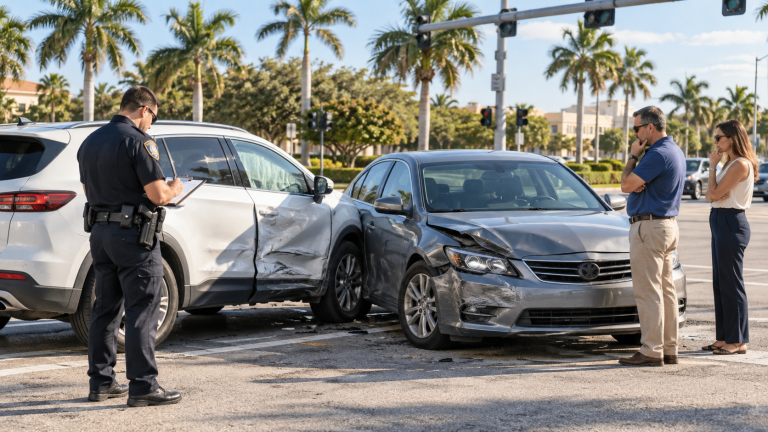
Learn whether you can still recover compensation if you were partly at fault for a Florida car accident and how Florida's modified comparative fault rule can affect your claim.
- You may still be able to recover compensation if you are 50% or less at fault for your own harm.
- Your compensation can generally be reduced according to your percentage of responsibility.
- If you are more than 50% responsible for your own harm, Florida's comparative fault statute generally bars recovery in applicable negligence actions.
- Insurance companies may attempt to assign you a larger percentage of fault to reduce the amount they have to pay.
- Crash reports, photographs, video, witnesses, vehicle data, and other evidence can become critical when liability is disputed.
- An insurance company's assessment of fault is not necessarily the final legal determination.
Florida's comparative fault rules can substantially affect both whether compensation is available and how much a personal injury claim may ultimately be worth.
After a car accident, determining who caused the crash is not always straightforward.
Maybe another driver ran a red light, but you were driving slightly above the speed limit. Perhaps someone changed lanes without looking, but you were distracted for a moment. Or maybe both drivers made decisions that contributed to the collision.
If you believe you were partly responsible for an accident in Florida, you may be wondering:
Can I still recover compensation?
In many cases, the answer is yes—but how much you can recover may depend heavily on your percentage of fault.
Florida follows a modified comparative fault system. Under Florida Statute § 768.81 , a person's damages generally are reduced according to their percentage of responsibility. However, if the injured person is found to be more than 50% at fault for their own harm, they generally cannot recover damages in a negligence action covered by the statute.
Understanding this rule can make a major difference when an insurance company attempts to place some—or most—of the blame on you.
What Is Comparative Fault in Florida?
Comparative fault is the legal system used to divide responsibility when more than one person contributed to an accident.
Instead of treating an accident as entirely one person's fault, Florida law allows percentages of responsibility to be assigned among those involved.
Direct answer: Florida comparative fault allows responsibility for an accident to be divided among multiple parties. If an injured person shares some fault, their compensation can generally be reduced by their percentage of responsibility.
Florida Statute § 768.81 provides that fault attributable to an injured claimant proportionately reduces the amount of economic and noneconomic damages that person can recover, subject to the statute's greater-than-50% limitation.
In practical terms, you do not necessarily have to be completely blameless to pursue compensation.
Example
Suppose you are injured in a Florida car accident and your total recoverable damages are determined to be:
$100,000
The other driver is found to be:
80% at fault
You are found to be:
20% at fault
Your damages would generally be reduced by your 20% share of responsibility.
Instead of recovering $100,000, your potential recovery could be:
$80,000
That is the basic concept behind comparative fault.
What Is Florida's 50% Rule?
Florida's comparative fault system changed significantly in 2023.
Under Florida Statute § 768.81 , a party who is found to be greater than 50% at fault for his or her own harm generally may not recover damages in a negligence action governed by the statute.
Direct answer: If you are 50% or less at fault, you may still potentially recover compensation, although your damages can be reduced by your percentage of fault. If you are more than 50% at fault for your own harm, recovery is generally barred in a negligence action governed by Florida's comparative fault statute.
That creates an important dividing line.
If You Are 10% at Fault
You could potentially recover 90% of your damages.
If You Are 30% at Fault
You could potentially recover 70% of your damages.
If You Are 50% at Fault
You may still potentially recover 50% of your damages.
If You Are 51% at Fault
You generally cannot recover damages under Florida's modified comparative fault rule.
That 1% difference can therefore have a dramatic effect on a personal injury case.
Does the 50% Rule Apply to Every Florida Personal Injury Case?
Not necessarily.
Florida Statute § 768.81 applies broadly to negligence actions, but the statute contains exceptions and limitations.
For example, the greater-than-50% rule specifically does not apply to personal injury or wrongful death actions arising from medical negligence under Chapter 766.
Different legal rules may also apply depending on the type of claim involved.
Because of these distinctions, the specific facts and legal theory behind a personal injury case should be evaluated carefully rather than assuming that the same comparative-fault rule applies identically to every accident.
How Is Fault Determined After a Florida Car Accident?
There is no single piece of evidence that automatically determines fault.
Insurance companies, attorneys, judges, and juries may evaluate numerous forms of evidence when deciding how responsibility should be divided.
Important evidence may include:
- Police crash reports;
- Photographs of the accident scene;
- Vehicle damage;
- Surveillance footage;
- Dash camera footage;
- Traffic camera video;
- Witness statements;
- Vehicle event data;
- Cell phone records;
- Road conditions;
- Traffic signals and signs;
- Skid marks and debris patterns;
- Medical records;
- Accident reconstruction evidence; and
- Statements made by the drivers.
The evidence becomes especially important when both sides give different versions of what happened.
Can an Insurance Company Decide That You Were Partly at Fault?
An insurance company can certainly make its own assessment of fault.
But that does not mean the insurer's percentage is automatically correct or legally binding.
Direct answer: An insurance adjuster can assign percentages of fault when evaluating a claim, but you do not automatically have to accept that determination. Evidence may support a different allocation of responsibility.
Insurance adjusters investigate claims for the insurance company. Their evaluation may affect settlement negotiations, but fault can ultimately become a disputed factual and legal issue.
“We believe our insured was 60% responsible and you were 40% responsible.”
An insurer making that statement does not necessarily mean the percentage is correct.
The available evidence may support a very different allocation of responsibility.
Why Insurance Companies May Focus Heavily on Comparative Fault
Comparative fault directly affects how much an insurer may have to pay.
If an insurance company can successfully argue that you contributed to the accident, it may reduce the value of your claim.
Example: $200,000 in Damages
- 0% responsible: potential recovery could be $200,000.
- 20% responsible: potential recovery could be reduced to $160,000.
- 40% responsible: potential recovery could be reduced to $120,000.
- 50% responsible: potential recovery could be reduced to $100,000.
- 51% responsible: the comparative-fault rule could prevent recovery altogether in an applicable negligence action.
The financial stakes become substantial very quickly.
That is why fault disputes are often one of the most important parts of a serious Florida personal injury case.
What Are Common Situations Where Both Drivers May Share Fault?
Many crashes involve allegations that more than one driver contributed to the collision.
Left-Turn Accidents
A driver turning left may fail to yield, while the approaching driver may have been speeding.
Lane-Change Accidents
One driver may change lanes without checking a blind spot while the other driver was following too closely or driving aggressively.
Rear-End Collisions
Rear-end crashes are often blamed on the following driver, but surrounding circumstances can sometimes make liability more complicated.
Intersection Accidents
One driver may fail to yield while another enters the intersection at an unsafe speed.
Distracted Driving Accidents
Both drivers may have been distracted immediately before the collision.
Multi-Vehicle Accidents
Multiple drivers may contribute to a chain-reaction collision.
Florida law allows fault to be allocated among responsible parties based on their respective percentages of responsibility.
What If You Were Speeding When the Accident Happened?
Speeding does not automatically prevent you from recovering compensation.
The important question is whether your speed contributed to causing the accident or increasing your injuries.
For example, imagine another driver runs a stop sign and crashes into your vehicle.
If you were traveling five miles per hour over the speed limit, the insurance company may argue that your speed contributed to the collision.
Whether that argument succeeds depends on the evidence.
The key issue is not simply whether you violated a traffic rule. It is how your conduct contributed to the accident and resulting injuries.
What If You Were Not Wearing a Seat Belt?
Seat belt issues can also arise in Florida personal injury litigation.
An insurer or defendant may argue that failing to wear a seat belt contributed to the severity of particular injuries.
However, that does not necessarily mean the person caused the accident itself.
The relationship between the conduct and the injuries must be evaluated based on the evidence.
These cases can involve medical testimony, crash reconstruction, and other expert evidence.
What If You Were Distracted?
Distracted driving can become important evidence when fault is disputed.
Examples include:
- Texting;
- Looking at a navigation system;
- Adjusting music;
- Eating;
- Turning to speak with a passenger;
- Reaching for an object; or
- Using a mobile device.
If distraction contributed to the accident, a percentage of fault could potentially be assigned to the distracted driver.
But the existence of some negligence does not automatically mean that driver bears most of the responsibility.
Can More Than Two People Share Fault?
Yes.
Florida negligence cases can involve multiple responsible parties.
For example, a collision may involve:
- Driver A;
- Driver B;
- Driver C;
- A commercial trucking company;
- A vehicle owner; or
- Another responsible entity.
Florida law generally requires damages to be apportioned according to each liable party's percentage of fault. The statute also provides procedures for defendants seeking to allocate fault to certain nonparties.
Multi-party cases can therefore become substantially more complicated than a simple two-car collision.
What Damages Can Comparative Fault Affect?
Florida's comparative fault statute applies to both economic and noneconomic damages in covered negligence actions.
Depending on the case, damages may include:
Medical Expenses
This may include emergency treatment, hospitalization, surgery, rehabilitation, physical therapy, diagnostic testing, medications, and future medical care.
Medical expenses can become one of the largest components of a Florida injury claim. For additional information about how accident-related treatment may be paid, see our guide to paying medical bills after an accident .
Lost Income
If your injuries prevent you from working, you may have lost wages or other employment-related losses.
Loss of Future Earning Capacity
Serious injuries can affect your ability to work or earn income in the future.
Pain and Suffering
Qualifying personal injury cases may include compensation for physical pain, emotional distress, mental anguish, and loss of enjoyment of life.
Property Damage
Vehicle repairs or replacement may also be part of the overall financial consequences of an accident, although property-damage claims can involve different insurance considerations.
If comparative fault applies, the amount ultimately recoverable may be reduced according to the claimant's percentage of responsibility.
Should You Admit Fault at the Accident Scene?
You should provide truthful information to police and others investigating the accident.
However, avoid making speculative statements such as:
- “It was probably my fault.”
- “I should have seen them.”
- “I was not paying attention.”
- “I'm sorry, I caused this.”
- “Maybe I was going too fast.”
Immediately after a collision, you may not know everything that occurred.
Another driver's actions, traffic-camera footage, witnesses, vehicle data, or physical evidence may later reveal important facts.
There is a difference between cooperating with an investigation and making assumptions about legal responsibility before all the evidence is known.
Be Careful With Recorded Statements
An insurance adjuster may ask you to provide a recorded statement regarding the accident.
What you say can potentially become important later.
Questions may focus on:
- Your speed;
- What you saw;
- When you noticed the other vehicle;
- Whether you were distracted;
- Whether you were using a phone;
- What lane you were in;
- Whether you braked;
- Whether you were wearing a seat belt; and
- What you remember immediately before impact.
Because comparative fault can directly affect whether and how much you recover, casual statements can take on significance in a disputed claim.
Evidence Can Be Critical When Fault Is Disputed
When an insurer argues that you were partly responsible for an accident, objective evidence may help establish what really happened.
Photographs and Video
Images of the scene can preserve vehicle positions, road conditions, debris, skid marks, signage, traffic lights, and damage patterns.
Witnesses
Independent witnesses may provide important testimony regarding the drivers' actions.
Surveillance Cameras
Nearby businesses, homes, traffic systems, or parking facilities may have recorded the collision.
Some video is automatically deleted after a short period, making early preservation important.
Vehicle Data
Modern vehicles may contain electronic information regarding speed, braking, acceleration, and other factors immediately before impact.
Cell Phone Evidence
In some cases, phone records may become relevant to allegations of distracted driving.
Accident Reconstruction
Serious or complex accidents may require specialists to analyze physical evidence and reconstruct how the collision occurred.
What Happens If You Disagree With the Insurance Company's Fault Decision?
You do not necessarily have to accept it.
A personal injury attorney may investigate the accident independently and challenge an insurer's allocation of responsibility using evidence such as:
- Witness testimony;
- Video footage;
- Photographs;
- Vehicle data;
- Accident reconstruction;
- Police evidence; and
- Other documentation.
The difference between being considered 30% responsible and 55% responsible can determine whether substantial compensation is available at all.
That makes disputed-liability cases particularly important to investigate thoroughly.
How Long Do You Have to File a Personal Injury Lawsuit in Florida?
Deadlines matter.
Direct answer: Under Florida Statute § 95.11 , an action founded on negligence generally must be commenced within two years, although exceptions and different deadlines may apply depending on the circumstances.
Waiting can create additional problems beyond the statute of limitations.
- Evidence can disappear.
- Witnesses can become difficult to locate.
- Surveillance footage may be erased.
- Vehicles may be repaired or destroyed.
- Memories can fade.
For those reasons, investigating a disputed-fault accident sooner can be important.
Example: How Comparative Fault Can Change a Florida Injury Claim
Consider this scenario.
A driver enters an intersection after failing to yield and hits another vehicle.
The injured driver suffers:
- A fractured leg;
- $45,000 in medical expenses;
- $15,000 in lost income;
- Additional future treatment; and
- Significant pain and suffering.
Assume the total legally recoverable damages are valued at:
$150,000
The evidence shows that the other driver was primarily responsible, but the injured driver was traveling somewhat above the speed limit.
Scenario One: Injured Driver Is 10% at Fault
Potential recovery:
$135,000
Scenario Two: Injured Driver Is 30% at Fault
Potential recovery:
$105,000
Scenario Three: Injured Driver Is 50% at Fault
Potential recovery:
$75,000
Scenario Four: Injured Driver Is 51% at Fault
Under Florida's current modified comparative fault rule, recovery could be barred entirely in an applicable negligence action.
This illustrates why even small changes in the percentage of fault can have enormous financial consequences.
Do Not Assume You Have No Case Because You Made a Mistake
Accidents are rarely as simple as they appear immediately afterward.
Even if you believe you contributed to the crash, another driver may bear most of the responsibility.
You may also be judging your actions more harshly than Florida law ultimately would.
The relevant question is not simply:
“Did I do anything wrong?”
The more important legal questions include:
- What caused the accident?
- Who contributed to the collision?
- How much responsibility should be assigned to each party?
- What evidence supports those percentages?
Those questions can determine whether you can recover compensation and how much your claim may be worth.
How Hogan & Hogan Helps With Disputed-Fault Florida Accident Claims
If an insurance company says you were partly responsible for an accident, that determination can have a major effect on your personal injury claim.
Under Florida's comparative fault law, you may still be able to recover compensation when you share some responsibility for an accident—but your recovery may be reduced according to your percentage of fault. If you are found to be more than 50% responsible for your own harm, you generally cannot recover damages in an applicable negligence action.
The attorneys at Hogan & Hogan, P.A. can review the circumstances of your accident, evaluate available evidence, address disputed liability, and help determine what options may be available.
If you were injured in a Florida accident and the insurance company is attempting to place some or all of the blame on you, contact Hogan & Hogan to discuss your case.
Frequently Asked Questions
Can I recover compensation if I was partly at fault for a Florida car accident?
Potentially, yes. Florida law generally reduces an injured person's damages according to that person's percentage of fault. However, under the current comparative fault statute, a person found to be more than 50% responsible for his or her own harm generally cannot recover damages in an applicable negligence action.
What happens if I am 20% at fault for an accident in Florida?
If your total recoverable damages were $100,000 and you were found 20% responsible, your damages could generally be reduced by 20%, leaving a potential recovery of $80,000.
Can I recover if I am exactly 50% at fault in Florida?
The statute bars recovery when a party is greater than 50% at fault for his or her own harm. Therefore, the statutory bar does not say that someone who is exactly 50% responsible is automatically prohibited from recovering. Their damages would still generally be reduced according to their percentage of fault.
What happens if I am 51% at fault?
In a negligence action governed by Florida Statute § 768.81, a party found to be more than 50% responsible for his or her own harm generally may not recover damages.
Does an insurance company's percentage of fault automatically decide my case?
No. An insurance company can make a liability determination for purposes of evaluating a claim, but its opinion is not necessarily the final legal determination of fault. Evidence may support a different allocation of responsibility.
Can both drivers be at fault for the same accident?
Yes. Florida's comparative fault system allows responsibility to be divided among multiple parties based on their respective contributions to the accident and injuries.
What evidence can help prove who was at fault?
Useful evidence can include crash reports, photographs, dashcam footage, surveillance video, witnesses, vehicle data, cell phone records, physical evidence from the roadway, and accident reconstruction.
How long do I have to sue after a Florida car accident?
Florida Statute § 95.11 currently provides a general two-year limitations period for actions founded on negligence, although exceptions and other deadlines may apply depending on the claim.
Should I speak to an attorney if the insurance company says I was partly at fault?
It may be particularly important to obtain legal advice when fault is disputed because your assigned percentage of responsibility can directly affect the amount you recover—and whether recovery is available at all.
Talk to a Florida Personal Injury Attorney
If an insurance company is attempting to place some or all of the blame for an accident on you, your percentage of fault can have a significant effect on the value of your claim.
Next step: Speak with Hogan & Hogan about the accident, the available evidence, the insurance company's fault determination, and your legal options.
Call (855) 464-2652
Final Takeaway
Being partly responsible for a Florida accident does not automatically mean you have no personal injury claim.
Florida's modified comparative fault rule generally allows an injured person who is 50% or less at fault to pursue compensation, with damages reduced according to that person's percentage of responsibility. A person found more than 50% responsible for his or her own harm generally cannot recover damages in an applicable negligence action.
Because a relatively small difference in the allocation of fault can dramatically change the outcome of a claim, evidence such as photographs, witnesses, surveillance video, vehicle data, police evidence, and accident reconstruction can become especially important.
You also do not necessarily have to accept an insurance company's initial assessment of fault. When liability is disputed, a thorough investigation can help determine what actually happened and how responsibility should be allocated.
Legal Disclaimer: This article is provided for general informational purposes only and does not constitute legal advice. Florida law and applicable deadlines can depend on the facts of a particular case. Consult a qualified Florida attorney regarding your specific situation.
